GRESB, CRREM, the EU Taxonomy: Which standard should guide your portfolio?

When it comes to sustainable real estate investing and management, standards and frameworks are incredibly important. They essentially guide everything, whether you’re acquiring new assets, offloading, or revamping existing ones.
You’ll hear a lot about three key initiatives: GRESB, CRREM, and the EU Taxonomy. Each has its own logic, strengths, and role to play. Ideally, real estate stakeholders, especially investors and managers, should push for the use of all three standards.
In fact, they’re not really even standards, so to speak. One provides benchmarks, one classifies assets, and one is a tool to bring existing buildings into the sustainability fold. You can probably already guess that each has its own importance, and that’s absolutely right.
The art lies in understanding when and how to use each. This article explores what each framework brings to the table, where they excel, and a practical strategy for weaving them together into a coherent portfolio-level approach.
Let’s get started.
What is GRESB?
GRESB (once the Global Real Estate Sustainability Benchmark – it dropped the expansion when it moved beyond real estate), is an assessment and benchmarking framework for real assets, run against the GRESB Standards. It’s an annual report of member organisations (real estate companies, funds, and portfolios) that compares and monitors sustainability performance across portfolios. And, more importantly, each year, they set benchmarks for members (and non-members) for guidance.
Read our complete guide on GRESB.
The GRESB Real Estate Assessment is built from three scored components: Management (30 points), Performance (70) and Development (70). Standing investments are scored on Management plus Performance. Development portfolios are scored on Management plus Development. Since 2025 there's also a Residential Component, for portfolios that are more than 75% residential by value.
Participants receive benchmark scores, peer comparisons, and a roadmap of ESG improvements. Institutional investors use the results to screen and engage managers.
Worth knowing where this is heading. Around 12% of the GRESB score currently comes from direct performance indicators – the rest is process. The GRESB Foundation has confirmed it's shifting that towards measured performance, first landing in the 2028 Standard, with an indicative 50–75% weighting long term. Final details are due in Q4 2026.
Keep in mind that GRESB isn’t a regulatory thing. However, it does connect to the disclosure regimes. There's a dedicated SFDR Real Estate Assessment covering the principal adverse impact indicators and, at indicator RC6, EU Taxonomy eligibility and alignment. There's no equivalent CSRD or ESRS module.
What is CRREM?
CRREM (Carbon Risk Real Estate Monitor) A carbon-risk framework built for real estate. It publishes decarbonisation pathways – more than 1,000 of them, across 44+ countries and every major property type – and tells you whether a building is on or off the 1.5°C track.
CRREM started as an EU Horizon 2020 project (grant 785058, 2018–2021). It's now published by the CRREM Foundation, an independent non-profit set up in the Netherlands in December 2024, funded by Laudes Foundation and five asset owners. Its job is to translate global climate goals (1.5°C/2°C) into building-level energy/carbon intensity pathways. It assigns target trajectories (for energy use, GHG emissions per square metre) for different building types, countries, and vintages. In simple words, it provides an asset-level assessment of whether a building is “on track” or at risk of being misaligned, in terms of sustainable performance.
What used to be the "stranding year" is now the CRREM Misalignment Year – the first year a building's carbon or energy intensity goes past its 1.5°C budget. CRREM renamed this in July 2025, and the rename was deliberate. Going over a pathway signals transition risk. It doesn't mean the market has repriced your asset. Those are two different claims and only one of them is CRREM's.
What is the EU taxonomy?
The EU Taxonomy is a regulatory classification system intended to define what economic activities can be considered environmentally sustainable. It’s part of the EU’s Green Deal and is designed to help the EU reach its objectives and goals for carbon neutrality and eventually net-zero emissions. In real estate, it offers objective criteria to assess whether a property or activity is “green” according to the EU’s climate goals.
To count as taxonomy-aligned, an activity must:
(a) Substantially contribute to one or more environmental objectives (e.g., climate mitigation or adaptation)
(b) Do no significant harm (DNSH) to any other environmental objective
(c) Comply with the minimum safeguards in Article 18 – due-diligence procedures aligned with the OECD Guidelines for Multinational Enterprises and the UN Guiding Principles on Business and Human Rights
(d) Meet the Commission's technical screening criteria for that activity
That fourth test is where the actual numbers live, and it's the one that decides whether your buildings qualify. There are six environmental objectives in total.
For buildings/real estate, eligibility and alignment depend on metrics such as specific thresholds, and for a portfolio owner they're the whole point:
Buying and owning buildings (activity 7.7). Built before 31 December 2020: EPC class A, or inside the top 15% of the national or regional stock by operational primary energy demand. Built after that date: it has to meet the new-build test below.
New construction (7.1). Primary energy demand at least 10% below the national NZEB threshold. Over 5,000 m², add airtightness and thermal-integrity testing plus a life-cycle global warming potential calculation, disclosed on request.
Renovation (7.2). Either compliance with the EPBD's major-renovation requirements, or a cut in primary energy demand of at least 30%.
One trap. The "operate it efficiently through energy performance monitoring" requirement under 7.7 is triggered by HVAC effective rated output above 290 kW – not by floor area. The 5,000 m² threshold is a different test doing a different job. They get conflated constantly.
The EU Taxonomy is increasingly being used for sustainable financing. It also works the opposite way round to how it's usually described. The obligation to report taxonomy alignment sits in Article 8 of the Taxonomy Regulation, and it applies to whoever the Accounting Directive says must publish sustainability information. CSRD set that population.
What changed in early 2026
This is the part of the post that dated fastest.
Directive (EU) 2026/470, published in the Official Journal on 26 February 2026, means mandatory taxonomy reporting now applies only to undertakings above both €450m net turnover and 1,000 employees, for financial years starting in 2027. Everyone below reports voluntarily, or not at all.
For most Nordic property companies, the compliance deadline you were planning around has gone. The lender asking for the same numbers has not.
Delegated Regulation (EU) 2026/73 then trimmed what's left of the reporting: a 10% materiality threshold, 64% fewer data points for non-financial undertakings and 89% fewer for financial ones, OpEx assessment optional where it's immaterial, and an opt-out for financial undertakings running to the end of 2027.
So the advice below still stands, but for a different reason. Taxonomy alignment matters because your bank asks for it, not because a directive tells you to file it.
What is each best at (in a real estate portfolio context)
GRESB, CRREM, and the EU Taxonomy are essentially three different frameworks, with one major overlap – they’re instrumental in making real estate portfolios more sustainable. With these, you can improve the environmental performance of assets through energy, water, and waste management, among other initiatives.
Here’s a quick guide on what each of these frameworks excels at and who it’s meant for:
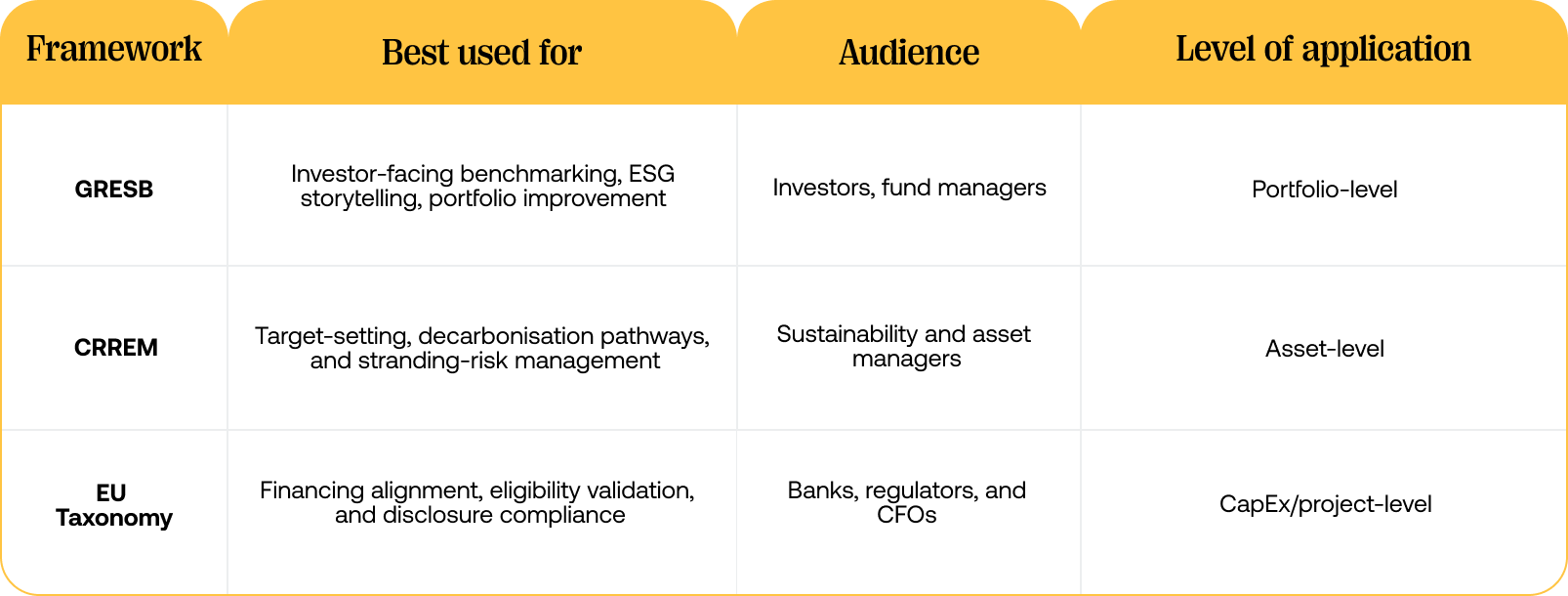
For most stakeholders, but particularly those financing real estate projects, it should make sense to use all three at some point. However, there are instances where a particular framework makes more sense. For example, if you have an asset that’s far behind industry benchmarks in sustainable performance, CRREM should be your go-to.
For newer projects, for example, both GRESB benchmarks and EU Taxonomy classifications can be useful.
Which one to use and when?
In practice, real estate portfolios should not pick one standard to “rule them all.” Instead, you need a layered strategy, ideally according to the needs of individual assets within the portfolio. After all, a diverse portfolio might have properties at different levels of environmental competency.
Here’s a playbook by priority or use case.
Investor signalling priority (for property owners and managers)
When the goal is to signal ESG credentials to investors, capital allocators, or external stakeholders:
- Start with GRESB. A strong GRESB score (or year-on-year improvement) is visible, comparable, and may even be required by institutional investors
- Then layer in CRREM pathways. Use decarbonisation trajectories as a back-end justification for how your portfolio will progress behind the score. This helps address questions from sophisticated (climate-aware) investors who want real solutions
Stranding-risk and retrofit focus (for both investors and managers)
If your primary concern is identifying assets that might become stranded or underperform due to tightening regulations or energy market stress, consider CRREM. As mentioned earlier, it can pinpoint which assets are off-path and quantify how far off-path they are.
Simultaneously, ensure that data fields are “taxonomy-ready” from day one (e.g., building-level energy intensity, emissions factors, age/durability, renovation timings). This ensures that as you retrofit or reposition, those upgrades are compatible with future regulatory compliance. In essence, this approach is data-first and risk-averse.
Financing priority
If your immediate priority is securing green finance, loans, or bonds, or satisfying eligibility thresholds for certain funds:
Lead with EU Taxonomy alignment. Taxonomy alignment is a legal precondition for the European Green Bond label, and lenders increasingly ask for it. What it isn't is a reliable route to cheaper money, and we'd rather say that than not. The green bond premium was small to begin with – roughly 8 basis points, and mostly for large investment-grade issuers – and research covering 2015 to 2025 finds it has compressed to nothing, or reversed. The pricing advantage that does show up in real estate attaches to demonstrably efficient buildings, not to the label on the paperwork. Uptake tells the same story: European green bonds were about 7% of European green bond issuance in 2025. Treat alignment as a gate you have to clear, not a discount you earn
Once aligned, report outcomes via GRESB. You can become a member or compare your assets’ performance with the publicly available most current benchmark
Where does data come into all of this?
Data is the common denominator when it comes to GRESB, CRREM, and the EU Taxonomy. Each of them, in their own right, requires detailed, granular data of the asset in question.
Let’s take CRREM as an example and see how data enables it to do what it does.
CRREM works by comparing your building’s actual performance in terms of energy intensity (kWh/m²) and carbon intensity (kgCO₂e/m²) to science-based decarbonisation pathways that are specific to the building’s country, asset type, and year of construction.
Suppose you manage a 20,000 m² office in Amsterdam, built in 2008. Your meter data shows 3,800,000 kWh a year. That's 190 kWh/m².
That number is where a CRREM assessment starts, and it's also where most of them fall over.
You need the fuel split, because gas and electricity carry very different emission factors and only one of them gets cleaner as the grid decarbonises. You need the right national factor for the right year – the Dutch list gives 0.328 kg CO₂e/kWh for grid electricity in 2024 and 0.268 in 2025, and the gap between those two is bigger than most retrofits. You need whole-building consumption with tenant areas included, because that's CRREM's scope, not the landlord's meter. And you need the floor area measured the way CRREM measures it – IPMS 2 gross internal area – not gebruiksoppervlak, or you're holding your building against someone else's ruler.
Get those four right and the pathway comparison is arithmetic. Get any one of them wrong and you've produced a confident number that means nothing.
You see where we’re going with this?
Data is what powers sustainability frameworks. It’s what helps you understand the EU Taxonomy requirements.
Pro-tips for using data (and mistakes to avoid)
- Find asset-level energy and emissions data (electricity, heating, cooling, fuel, refrigerants) mapped to floor area and normalised intensities
- Use historical consumption time series, weather normalisation, and occupancy data
- Track capital expenditure (capex) and operational expenditure (opex) on energy or sustainability upgrades
- Keep detailed building metadata (year built, envelope, HVAC systems, renovation history), which can be useful in setting realistic baselines.
- Maintain regulatory context, emissions factors, and grid intensity data (where available).
- Benchmark and peer data to calibrate assumptions (e.g., industry decarbonisation curves)
- Invest in data integration tools and ESG platforms to automate collection, validation, and alignment (versus manual spreadsheets).
And as you do all of this, watch out for the many pitfalls that arise when data is missing, inconsistent, or lacking traceability. Without good data, you risk misreporting, greenwashing, or underestimating risks.
One dataset, three lenses
GRESB, CRREM, and the EU Taxonomy each offer indispensable but distinct ways to view portfolio performance, risk, and eligibility. GRESB functions as your ESG scoreboard, CRREM is your technical decarbonisation roadmap and risk detector, and the EU Taxonomy acts as the regulatory gatekeeper for green financing.
Your use of each may depend on current goals and circumstances. However, at the heart of all of this is data. Since energy usage is a major driver of the environmental performance of buildings, it’s one of the first things you’d want sorted.
All three frameworks bottom out in the same place: what your buildings actually used, asset by asset. CRREM wants whole-building consumption with tenant areas included. The taxonomy's top-15% test wants primary energy demand you can defend to a lender. GRESB is moving its score towards measured performance and away from process. None of that runs on estimates, averages, or a spreadsheet somebody updates each quarter.
That's the job comundo does. Energy data straight from the supply, down to the individual asset. No hardware. No metre requirements. One source of truth for the whole portfolio.
It’s this correct and relevant energy data that can help you compare performance with GRESB benchmarks or use CRREM to calculate the risk of stranding. Data, and even more so, energy data, is the key to making the best of frameworks, standards, and more pathways to a green future.