ESRS: A beginner's guide to the EU's sustainability reporting standards.
- GHG Protocol
- Frameworks
- Legislation

We have exactly 25 years to reach the goal of becoming net zero by 2050. That means efforts to assess, target, and reduce emissions must be ramped up.
The European Union (EU) has released a comprehensive environmental, social, and governance (ESG) reporting framework called the European Sustainability Reporting Standards or ESRS. These standards provide the framework for implementing the Corporate Sustainability Reporting Directive (CSRD). Yes, lots of initialisms there!
CSRD, and by extension, the ESRS, have completely changed ESG reporting. The directive widened ESG reporting beyond its predecessor, though 2026 reforms have since narrowed who actually has to report. And the standards cover more ground in terms of the environmental and social impact of businesses operating in the EU bloc.
This guide will cover the ESRS thoroughly to help you understand what the standards cover and how to go about reporting. The actual document is well over 250 pages, so consider this a succinct summary of the main takeaways.
What is ESRS?
ESRS provides the framework for reporting ESG data, as per the CSRD. After the 2026 Omnibus reforms, that mandatory reporting applies to large companies with more than 1,000 employees and over €450 million in net turnover – a much smaller group than the nearly 50,000 companies the directive originally covered. It was developed by the European Financial Reporting Advisory Group (EFRAG) and consists of 12 standards divided into four categories: general, environmental, social, and governance.
The purpose of this framework is to provide guidelines for enterprises on what data to report and how to report it. It standardises and streamlines reporting for all affected entities so that the data is comprehensive, verifiable, and comparable.
At the moment, ESRS guidelines aren't specific to a sector, so they can be used by any company from any industry. As for the geographic scope, ESRS is primarily for EU businesses, but non-EU businesses with operations in the EU may also need to follow the standards for reporting in the later stages of CSRD's implementation. So, in essence, ESRS standards are far-reaching.
Double materiality assessment
According to the CSRD, double materiality is a key condition for reporting. It forms the basis of the actual reporting, i.e., what needs to be reported. Companies must perform a double materiality assessment to determine which standards to use for reporting. In other words, businesses must only report on standards relevant to them.
Double materiality involves assessing the impact of sustainability issues on the company's financial performance as well as the impact of the company on the environment and society. EFRAG has also published guidelines on materiality assessment to accompany the official ESRS documents.
ESRS reporting framework
Here are the 12 standards that make up the ESRS:
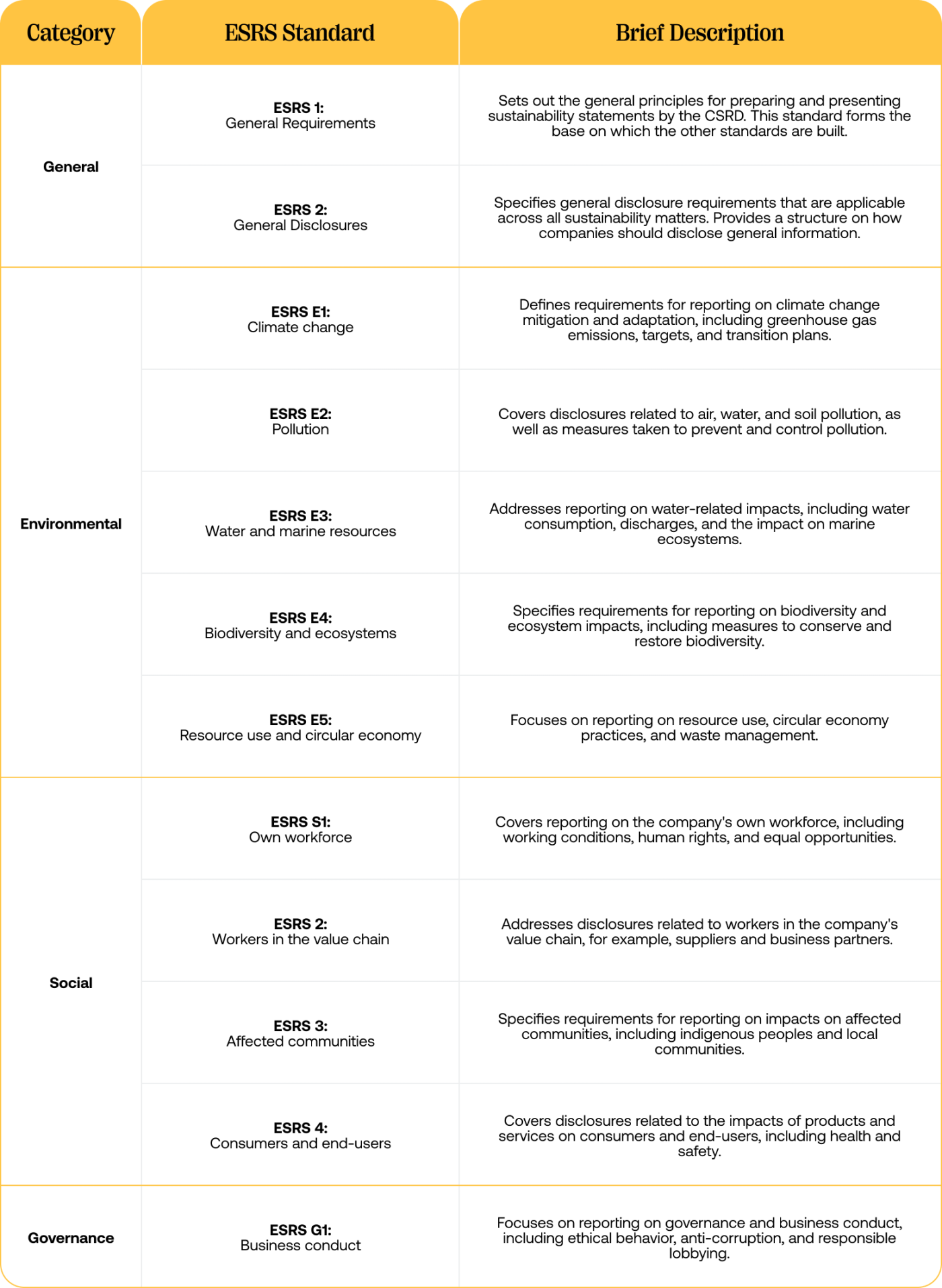
Sector-specific ESRS
EFRAG had been working, on behalf of the European Commission, on sector-specific standards for industries like mining, oil and gas, transportation, and finance – disclosures aimed primarily at industries with high reliance on fossil fuels and a big carbon footprint. Under the 2026 Omnibus reforms, that work was discontinued. There are no sector-specific ESRS coming; the sector-agnostic standards apply to all reporting companies.
ESRS for SMEs
The 2026 Omnibus reforms changed the picture for SMEs significantly. The EU originally planned a mandatory simplified standard for listed SMEs (the LSME), but that plan was scrapped and listed SMEs were removed from mandatory CSRD scope altogether. There's no SME version of ESRS you're obliged to follow.
What remains is the VSME – a voluntary standard for SMEs not covered under the CSRD, which EFRAG developed and the European Commission is finalising in 2026. It can be followed voluntarily and is supposed to encourage SMEs to start reporting. It can also benefit them when responding to reporting requirements from other entities like banks or partners – and it sets a cap on how much sustainability data a large customer can ask a company with fewer than 1,000 employees to provide.

How to report using ESRS?
Your organisation can create reports using the guidelines from the official ESRS documents published on the EFRAG website. It's best first to familiarise yourself with the ESRS, particularly the cross-cutting standards as those are required to be followed by all companies.
Here's a step-by-step guide to ESRS reporting:
1. Conduct materiality assessment
The first step is to complete a double materiality assessment for your organisation following the guidelines from EFRAG (Implementation Guidance or IG 1). This assessment will help you determine which topical standards to consider and include in your annual report.
This process involves engaging with stakeholders and analysing operations, products, and relations. Identify impacts, risks, and opportunities (IROs) for both sustainability impacts on your business and your business's impact on the environment and society.
2. Conduct value chain assessment
The next step is to understand and assess your value chain in line with EFRAG's implementation guidance IG 2. It will help you determine your upstream and downstream value chains and how they will impact your reporting. For example, if parts of your value chain are impacting biodiversity, it would be material for you to report using the ESRS E4 standard.
3. Identify material topics and data points
Based on the assessments above, identify the material topics that you'll report on. This is important because you'll need to read and understand the guidance for the corresponding topics and report on the specific data points for that topic. The original standards listed over 1,100 data points, though the revised 2026 set cuts the mandatory ones by more than 60%. You don't have to collect and report data for all – only the general ones and the topics that are material to your organisation.
4. Collect data
Start gathering data for the general disclosures as well as topic-related disclosures based on the listed data points. Engage with stakeholders, partners, suppliers, and consumers to collect relevant data.
Utilise ESG software to collect, organise, and verify data. For instance, comundo can help organisations gather energy data from their real estate assets (offices, facilities, investment properties, etc.). Some solutions may directly comply with ESRS to make data reporting easy. Determine if there are any data gaps and how they may be resolved.
5. Draft report (General standards)
Create a separate section that covers general requirements and disclosures (ESRS 1 and 2). These two cross-cutting standards apply to all entities, so will be covered in all reporting.
ESRS 1 simply sets the general requirements to clarify concepts and principles. And those requirements must be followed throughout the reporting. It's ESRS 2 that covers the bulk of the data reporting (general disclosures). It includes four areas: IROs, governance, strategy, and metrics and targets.
6. Draft report (Topic standards)
Create a separate section in your report for each of the material topic standards. In theory, you may have reported some of this data in general disclosures, but the data points in topic standards take a deeper dive into the relevant category. Again, use dedicated ESG tools to compile data for the corresponding data points and create the report.
7. Validate data
Once the report is compiled and all the data has been included, validate it to ensure accuracy. You may work with professionals to validate your reporting.
Potential challenges with ESRS
ESRS is relatively new and quite comprehensive. Companies using it for the first time may run into issues. Here are some challenges and potential solutions:
Data collection
Of course, the biggest challenge in ESG reporting is collecting accurate and complete data. ESRS standards like ESRS E1 require reporting on value chain emissions, which can be challenging to find.
Engaging stakeholders in the value chain, collecting data from them, and using powerful tools to automate this process can make data collection much more straightforward.
Training
Companies may need to provide training to their personnel for working with ESG and carbon accounting tools. They may also need to educate employees about ESRS, especially if they're not directly involved in ESG reporting. Although it would be an investment, hiring ESG professionals to conduct workshops can start the ESRS reporting on the right foot.
Costs
CSRD and ESRS reporting will require businesses in the EU to invest resources to comply. Depending on the size and complexity of the companies, the cost may be significant.
This upfront cost may be sizeable, but for the large companies still in scope, compliance isn't optional. However, if done right, this report can help businesses cut down on costs and explore new revenue opportunities.
Prepare and conquer
Implementing CSRD and ESRS is phased, which means not all companies may have to comply immediately. Still, it's better to prepare in advance and be ready to file your ESG report.
Take the time to read the official documentation. Invest in the best ESG solutions that help you gather and organise data according to the requirements. Work with ESG professionals to prepare and validate your reports. That will prevent any hiccups and ensure that your report meets the standards.
FAQs
What is the difference between CSRD and ESRS?
Corporate Sustainability Reporting Directive (CSRD) is legislation adopted by the EU to make ESG reporting mandatory for large companies operating in the region (since 2026, those with more than 1,000 employees and over €450 million in net turnover). ESRS, on the other hand, is the guiding framework that helps companies comply with the directive.
Who created ESRS?
The European Financial Reporting Advisory Group (EFRAG) created the ESRS drafts after consultations with stakeholders, on behalf of the European Commission.
Who does ESRS apply to?
ESRS standards must be followed by large companies that must report ESG data as per the CSRD. ESRS doesn't apply to SMEs – and since 2026 there's no mandatory simplified version either. Smaller companies can instead use the voluntary VSME standard.
What is the function of ESRS?
ESRS are a group of 12 standards that provide guidelines for reporting ESG data for companies in the EU impacted by the CSRD. It sets the requirements and presents data points for general and topical disclosures.
Does ESRS require scope 3?
ESRS requires companies to report Scope 3 data as part of its ESRS E1 standard (Climate Change). It references the GHG Protocol for reporting emissions data, including value chain emissions. Only companies that determine that the E1 standard is material to their organisation must report (which is the majority).

Ryan Stevens
Technical content creator
Ryan is a senior technical content creator, helping tech businesses plan, launch, and run a successful content strategy. After an extensive academic career in engineering, he worked with dozens of tech startups and established brands to reach new clients through proven content creation strategies.