DGNB certification for buildings: Sustainable construction.
.webp)
DGNB certification is among Europe's leading certifications for sustainable buildings and beyond.
Started in Germany, it’s been adopted by the real estate sector in many countries to showcase their commitment to a greener planet. It’s a certification system that buildings can use at any stage, from planned to existing. While a certification like DGNB is optional in most countries, the need for it is greater than ever. The UNEP, United Nations Environment Program puts the buildings and construction sector at around 37% of global CO₂ emissions and nearly half of all material extraction – so it's no wonder this certification has gained traction.
Nearly half of global material extraction is the number that's changed the conversation. Operational energy used to be the whole story. It isn't any more.
In this article, we’ll cover the meaning of DGNB, what it entails, and the different levels of certification that buildings can achieve. If you’re considering building sustainability certification, this one’s for you!
What is DGNB?
DGNB stands for Deutsche Gesellschaft für Nachhaltiges Bauen, which translates to the German Sustainable Building Council. It was founded in 2007 as an independent non-profit organisation to promote sustainable buildings. The DGNB certification, which entered the market in 2008 and awarded its first 16 certificates in January 2009, is a planning and optimisation tool for buildings, interiors, and districts. It provides the framework for projects in the construction industry, ranging from new construction to deconstruction, through different variants.
DGNB now reports more than 12,000 projects awarded in around 30 countries. Read that carefully, because the number is often quoted wrong. It counts awards, which include pre-certificates as well as full certificates, and it counts projects – a district or an office fit-out is one project, not one building. The large majority are in Germany.
The DGNB certification criteria continuously evolve according to the building sector's requirements, regulations, and developments. DGNB works with partner organisations worldwide to help implement cohesive yet localised standards for achieving sustainability in construction. Certificates are issued by DGNB GmbH, an accredited certification body under DIN EN ISO/IEC 17065. That accreditation is why lenders and investors take the certificate seriously – it's not DGNB vouching for itself.
The DGNB system explained
The DGNB certification system is markedly different from other certifications in that it focuses on three essential paradigms, which include:
- Lifecycle assessment
- Holistic approach
- Performance orientation
With the lifecycle assessment, the certification accounts for a project's impact throughout its life, from planning to construction to use to deconstruction/decommission. It takes a holistic approach to buildings, measuring impact on ecology, economy, and socio-culture. Lastly, it considers a project's overall performance in the context of its purpose and use.
The quality measure behind the award is divided into six areas. These weightings are from the DGNB System New Construction, Buildings, Version 2026 International:
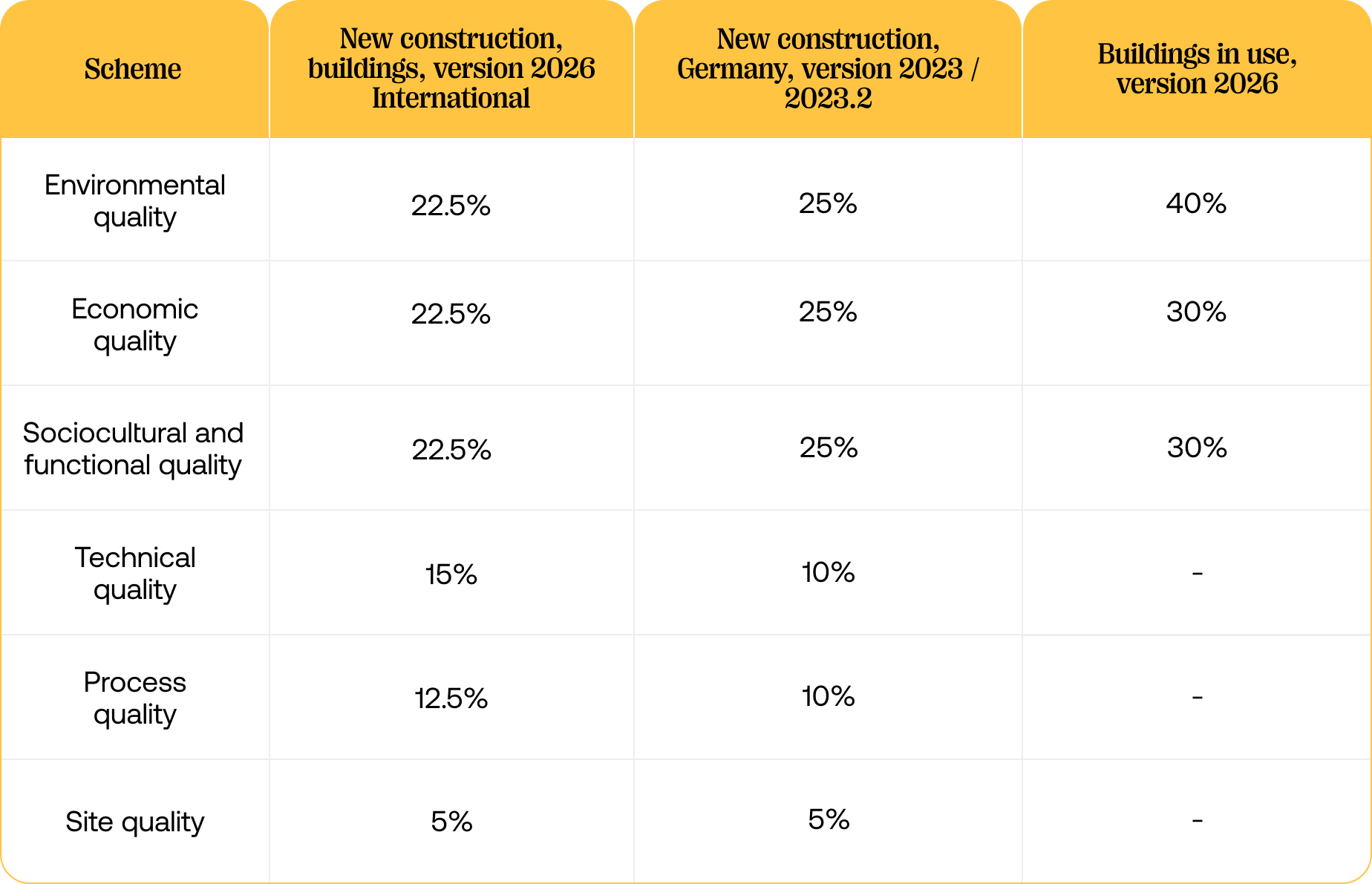
Germany runs a separate version. In the DGNB System New Construction, Buildings, Version 2023, the three main areas take 25% each and technical and process quality drop to 10% each. Always check which version a DGNB figure refers to before you quote it.
The environmental, economic, and sociocultural/functional qualities are equally weighted and serve as the primary criteria for assessment. For a holistic approach, the technical and process quality is also measured. However, these measures have a smaller contribution to the overall weight of the assessment.
Lastly, the certification considers the location, at 5% – and unlike the other five areas, this one sits inside the total score rather than beside it. It applies to new construction and renovation. The system for buildings in use drops it entirely: that one runs on three areas only, weighted 40% environmental, 30% economic and 30% sociocultural.
.webp)
Types of DGNB certification systems
DGNB has created different variants of the system to better cater to the phases of a building or construction project. Each phase has specific requirements, so the system corresponds to those requisites. Similarly, the actors involved in every phase are also different. For instance, for a building under construction, the actors would be a construction company, whereas for a building in use, the actors would be the owners and inhabitants.
The DGNB variants cater to the different phases of the building throughout its lifecycle. It is a lot of systems. Here's what each one is for:
- New construction
- Renovation
- Buildings in use
- Interiors
- Districts
- Construction site
- Deconstruction
New construction
The DGNB systems for new construction aim to make a building project sustainable from the start – sustainability goals set in the planning phase, risks caught before they're built in. You can take a pre-certificate during planning and construction and convert it to a full certificate on completion. Districts work the same way, on their own separate system: there the pre-certificate runs for three years and the certificate for five.
The system for new building construction also has an international version that accommodates the different regulatory requirements of different countries. It’s an adapted form of the original system made for Germany and other EU countries. The DGNB's new construction system has schemes for a long list of building types, including residential buildings, offices and administrative buildings, assembly buildings, department stores, shopping centres, hotels, logistics buildings, healthcare buildings and laboratories. Car parks exist too, but only as a pilot scheme.
Renovations
This DGNB system is designed to renovate existing buildings and provides guidelines on making them more sustainable within a given budget. It targets protection of resources, pollution, and waste to make buildings more sustainable through renovations. This certification also considers any special requirements by building type. It can be applied to educational buildings, department stores, hotels, shopping centres and residential buildings with more than six units.
Buildings in use
The DGNB system for buildings in use is a tool for transforming and managing existing buildings to take them closer to carbon-neutral status. It can be used by building owners or operators to reduce climate change's impact through steps according to the building type, design and resource usage. Unlike the system for new buildings focusing on materials and construction practices, this system targets operational aspects that can be improved and made more sustainable.
Interiors
The DGNB system for interiors targets the interior spaces of buildings, particularly offices, restaurants, retail stores, bank branches and hotels. Also, a building itself doesn’t have to be certified for its interior to get the certification. This system treats the interior as a standalone part of the building, eligible for its own accreditation.
Districts
DGNB also offers certification for entire districts. The guidelines differ by district type, as each has its own requirements. The system caters to different schemes, including urban districts, business districts, commercial areas, industrial sites and event areas. From green transportation to circular economy, the DGNB system for sustainable districts helps implement well-researched and practical measures for going green.
Construction site
A construction site has a large carbon footprint, so DGNB also provides a system for making these sites more environmentally friendly. This system, designed for construction planners, has five quality criteria:
- Construction site organisation
- Protection of resources
- Health and social aspects
- Communication with the local community
- Construction quality
Deconstruction
The DGNB system for the deconstruction of buildings certifies deconstruction projects that help minimise the impact of such activities. It follows five principles that, in turn, highlight transparency and commitment to the environment and people.
DGNB certification levels
The DGNB certification is a fully independent process with high transparency. As a result, it’s accepted and respected by organisations worldwide. Buildings and construction projects can obtain three levels of certificate: Platinum, Gold and Silver. A fourth level, Bronze, is available for buildings in use and existing buildings – it replaces the lowest level, "Certified", for existing real estate. Bronze isn't available for new construction or for renovation.
The level of certification depends on the degree of fulfilment of the requirements in the specific system. An overall degree of fulfilment is calculated across the six topic areas above. Based on this number, the level of certification is assigned to a building. Here’s the DGNB rating system:
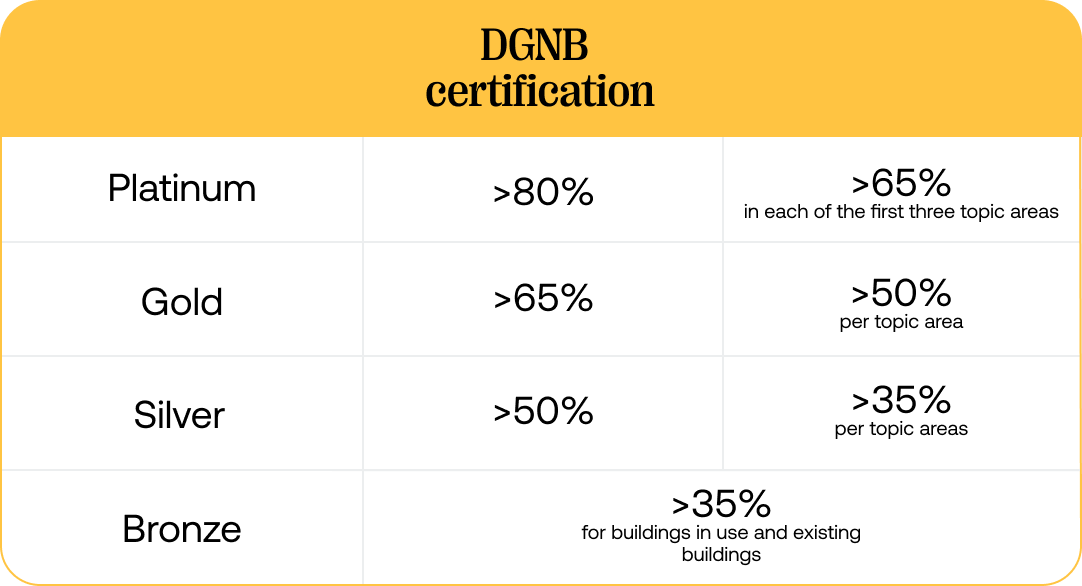
That second column is the part almost every DGNB explainer leaves out, and it's the one that catches people. A building can clear 80% overall and still miss Platinum, because it fell short in one of the three main areas. If you're targeting a level, check the weakest area first – not the average.
DGNB also has awards for projects that exceed expectations:
- The DGNB Diamond is an award for design quality and Baukultur, assessed on site by an independent commission. You can only get it if the project already holds DGNB Gold or Platinum
- The DGNB Climate Positive award goes to buildings shown to be operating at least climate-neutrally on the basis of their real consumption data – a negative CO₂ balance over a full year, measured, not modelled. It's the one DGNB award you can't earn without a year of actual meter data. DGNB is currently updating it alongside the 2026 version of the Buildings In Use system
- The DGNB special award Ecolabel is a supplementary award, developed with HafenCity Hamburg GmbH and given alongside a standard DGNB certificate. It applies in four named Hamburg development areas – HafenCity, Billebogen, Grasbrook and Science City Hamburg Bahrenfeld – where certification is a condition of the land allocation
There are others – Social Positive, an allergy-friendly building award, DGNB Flex, and a "Construction ready" certificate.
DGNB certification and compliance
DGNB certification requirements have been set in line with environmental regulations, particularly those in the EU. The guidelines in the various systems consider the EU taxonomy for sustainable activities.
The DGNB ESG Verification for the EU Taxonomy is a separate, paid service, aimed at the financial sector, developers and owners of existing buildings. It covers three economic activities – new construction, renovation, and acquisition and ownership – against three taxonomy objectives, plus do-no-significant-harm and the minimum safeguards.
Be clear about what it gives you. It's independent proof that a property or an activity meets the taxonomy's technical screening criteria. The reporting obligation still sits with the company, under Article 8 of the Taxonomy Regulation. The verification is an input to that disclosure, not a substitute for it.
One timing note if you're planning this: from 2027, projects can only be submitted by someone holding DGNB's "Examined Expert on EU Taxonomy" qualification.
Why consider DGNB certification?
A certification like DGNB for a building under construction or already constructed can have multiple benefits. Here’s why real estate builders, management, and investors should seek this particular certification:
Shows commitment to sustainability
DGNB-certified buildings are optimised in their construction and performance and, which usually means a smaller carbon footprint than an equivalent uncertified building. It shows a strong commitment to sustainability to all stakeholders, whether potential buyers or residents. Any company or individual with a stake in a real estate property can attain DGNB certification by completing the requirements. Furthermore, there are levels to the certification, making it a good choice for buildings moving toward a carbon-neutral state.
Flexible requirements
DGNB has created systems for various building scenarios, from planned construction to deconstruction. The systems are tailor-made to fit the application. More importantly, the guidelines cover all the aspects related to the building.
Financial incentives
JLL research puts rental premiums for green-certified offices at 7.1% to 11.6% across global markets. The 11.6% is the top of that range: it's the average rent uplift associated with BREEAM certification across 592 Central London office deals between 2017 and 2021, with capital values 20.6% higher.
The investor side has moved, and not in the direction you'd expect. CBRE's European Investor Intentions Survey found 32% of investors willing to pay a premium for sustainable assets in 2023. By 2026 that was 11%. The series in between reads 18%, then 13%.
Before you read that as investors losing interest, look at CBRE's own explanation: sustainability has stopped being a premium feature and started being the baseline. And of the investors who would still pay, more than 80% would pay 6% or more. The premium hasn't shrunk – the number of assets that can command it has.
Helps with compliance
Certification generates a lot of the evidence regulators, lenders and investors ask for. What it doesn't do is discharge a legal obligation, and it's worth being precise about that.
Take the EU Taxonomy, since DGNB's systems are built against it. The buildings criteria don't recognise certification at all. Acquisition and ownership turns on EPC class A or the top 15% of the national stock. New construction turns on primary energy demand at least 10% below the national NZEB threshold. Renovation turns on EPBD major-renovation compliance or a 30% cut in primary energy demand. BREEAM's own guidance says its assessment "can be used to support" taxonomy compliance – support, not satisfy. WorldGBC and EPRA are actively lobbying the Commission to let certifications stand in for EPCs, which tells you they currently can't.
There is one place a certificate unlocks money directly, and it's worth knowing if you build in Germany: under KfW's Klimafreundlicher Neubau programme, a DGNB certificate in Silver, Gold or Platinum combined with the QNG-PLUS or QNG-PREMIUM seal raises the eligible loan from €100,000 to €150,000 per residential unit.
So: certification is a strong evidence base and, in one market, a funding tier. It isn't a shield against penalties. Sanctions under the CSRD and taxonomy architecture attach to failing to disclose, not to being non-aligned.
What changed in 2026
DGNB released a new version of its Buildings In Use system in February 2026, and it's the most significant change to this scheme in years – because of what it's aligned to. The criteria are now harmonised with the EU Taxonomy, the ESRS, the CSRD and CRREM. DGNB Platinum for a building in use now requires proof against the taxonomy's climate mitigation and adaptation criteria.
That puts one certification scheme at the junction of four frameworks that most portfolio owners are already reporting into separately. It also means the scheme is only as good as the consumption data you feed it. Buildings in use are assessed on operational performance, and the Climate Positive award is decided on measured meter data for a full year. Neither runs on estimates or averages.
Which is where most portfolios get stuck. Not on the criteria – on the data.
FAQs
What are the levels of DGNB certification?
There are four levels of DGNB certification: Platinum, Gold, Silver and Bronze. The DGNB Platinum certification is the highest, followed by the DGNB Gold certification. The DGNB Bronze certification is for buildings in use and existing buildings, and isn't available for new construction or renovation. There's also a pre-certificate, which you can take during planning and construction and convert on completion.
How many buildings have a DGNB certification?
DGNB reports more than 12,000 projects awarded, in around 30 countries, with the large majority in Germany. Note that the figure counts projects rather than buildings, and includes pre-certificates alongside full certificates.
Where to apply for DGNB certification?
Registration happens in the DGNB System Software. Three parties have to be registered – the applicant, the project manager and a DGNB Auditor.
If you're in Denmark, you don't go to DGNB directly. Denmark has its own DGNB System Partner, Rådet for Bæredygtigt Byggeri, as do Austria, Switzerland, Spain and Croatia, and certification runs through them on a locally adapted version of the system. Start there.
DGNB certification can be applied by registering your building project online at the DGNB portal.

.webp)